

That Time Everything Went Wrong (And I Won a World Championship)
Perfection isn't necessary. You just have to keep going.

Triple Threat Life is a weekly newsletter with practical tips and mindset techniques to help multisport athletes succeed. Some installments are free. Some benefits are for paid subscribers only. Sign up here.

Today, I want you to join me on a journey.
We’re going back in time, a little over two decades, to when I competed as an equestrian. I want to share a story about the competition where everything went wrong, and I won a World Championship.
Then, I’ll bring it back around to today and explain how the skills I learned back then have carried over into endurance sports- specifically triathlon- as well as everyday life.
That time everything went wrong (and I won a World Championship)
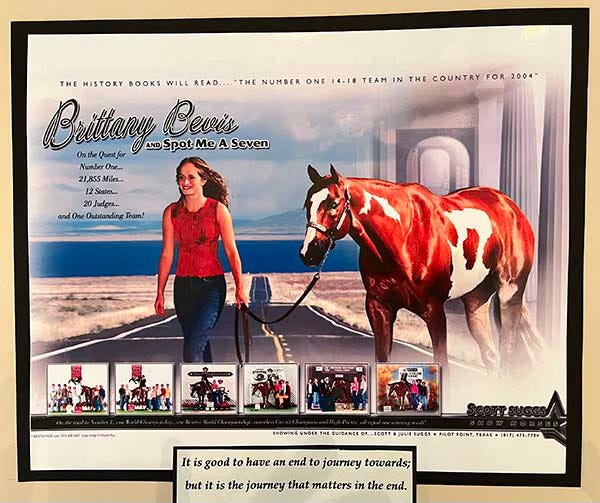
The year was 2004. I was at the APHA Youth World Championship with my longtime partner, Spot Me A Seven, better known as “Harley.” A big, strapping gelding with an awkward streak, Harley was dependable, reliable, and, up to that point, we were well on our way toward achieving the ultimate goal of being named the #1 youth team in the country (a title based on points accumulated at competitions throughout the year).
But the World Championship was the highlight of the year, and since it was my last year of youth eligibility, there was added pressure.
5 preliminary rounds narrowed down 109 competitors to the top 20. Then, it was time for the finals.
A bit of backstory: the class we were competing in was Showmanship- a pattern-based class that was most decidedly our thing. For whatever reason, we had a knack for combining technical skills with precision and style to receive big scores from the judges. If we went to a regional show, we were the team to beat. But at the World Championship, there were a half a dozen equally talented competitors all gunning for the top spot.
Many of you are probably watching the Winter Olympics, and much like snowboarding, where you fall in the run order will have an effect on your score.
Why? Judges are less likely to give out big scores to those that go early in the order. It’s just human nature. They’re waiting to see something that makes them sit up and take notice. They need a benchmark for comparison.
So, forbid you draw the number one spot. If you do, you’d better pull out something spectacular and make everyone rise to meet it.
You can probably guess which spot I drew…
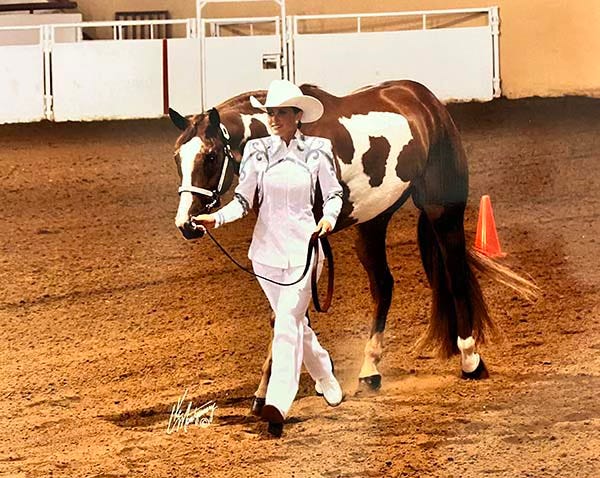
So, here we go. First up in the finals. Currently leading the nation in this discipline. Hundreds of people sitting in perfectly quiet stands, watching, waiting. A 3-minute-long run to determine the next World Champion.
No pressure.
The first maneuver was an extended trot in a serpentine across the arena. Speed and style go hand in hand in this class, and Harley was big and fast, so we could push this section to gain some bonus points. Halfway across the arena, he stepped on the back of my foot.
Let me reiterate. A giant, 1,500 lb. horse stepped on my foot. I didn’t hurt, but I darn sure nearly fell on my face. It felt like I did, but when I watched the video replay, I could hardly see where it happened.
Lesson #1- As athletes, we’re often super critical of our own performance. But in reality, what you think is a big deal, other people don’t even notice.
What could I have done? Dwell on the mistake, making it seem worse than it really was. Lose focus. Get distracted. Let it impact the rest of my performance.
What did I do? There was nothing I could do except to continue moving forward. Don’t look back. Like it never even happened.
Lesson #2- When something goes wrong, you have a choice to make. Will you dwell in the past or live in the present? The past is gone. You can’t change it, but you can impact the future with the choices you make next.
Results: 1st, 3rd, 2nd, 3rd, 2nd = World Champion
Just for fun- (I wrote this memorial about Harley when he passed in 2022 if you want to learn more about this amazing horse.)
Hi! Triple Threat Life is a reader-supported publication. If you enjoy this newsletter, please consider supporting my writing by upgrading to a paid subscription (and you get some cool benefits too.)
What to do when everything goes wrong
Fast forward to 2026, and these days I ride a different type of saddle. I don’t compete for judges’ scores, but against myself and the clock (a refreshing change). Still, the lessons I learned back then, about focusing forward and not letting adversity determine the outcome, have certainly carried over into the sport of triathlon.
What does this look like in endurance sports? I’m glad you asked! I have a few great examples, courtesy of my amazing friends (because I don't like just talking about myself.)
#1- Claire- 70.3 Wisconsin- During the extremely bumpy bike, her rear bottle cage completely fell off. She stopped once to stuff it into her shirt and tried to ride with it. Realizing that wasn’t going to work, she stopped again, found a few nice ladies spectating, got their number, and they offered to keep it for her until the race was over. Continued on to have one of her best run splits at this distance.
Still placed 7th in her age group.
#2- Mack- 70.3 Wisconsin- During the bike, she came through a tight section with a lot of traffic and got stuck behind Claire. She was determined not to draft, but had nowhere to go behind her either. The ref saw two matching kits riding together and immediately dinged her with a 2-minute drafting penalty. She was understandably upset and had to figure out how to let it go and refocus to get ready for the run.
Still placed 10th in her age group.
#3- Matt- 70.3 Augusta- Toward the latter portion of the bike, he felt something bump his saddle. It was a piece of his bottle cage coming loose. Was able to grab the bottle before the entire thing came crashing to the ground. Continued on to have one of his best bike performances yet.
Still placed 22nd in his age group.
If you want a global example, consider the women’s 4x7.5-kilometer relay at the Winter Olympics. Sweden’s Ebba Andersson crashed, lost a ski, and couldn’t get it back on. She continued moving forward, with only one ski, while carrying the broken one, until the team tech could get her a replacement. Sweden didn’t win the gold medal that day, but they won the silver.
All because she didn’t give up.
The moral of the story is this: Things do not have to go perfectly to have a great race. In fact, things rarely go perfectly, especially in triathlon. Expect the unexpected.
If something goes wrong, figure out how to deal with it.
Take a moment to process. Analyze the situation. Decide how you’re going to respond. Let go of any emotions and move on.
Don’t look back. You’re not going that way.
Focus forward.
Great reminder that a misstep doesn't determine the final outcome provided you don't dwell on it