

Chattanooga 70.3 Cooling Protocol: 10 Smart Strategies For Hot Races
Grab my super secret cooling plan for hot races that actually works!

Triple Threat Life is a weekly newsletter with practical tips and mindset techniques to help multi-sport athletes succeed. Some benefits are for paid subscribers only.
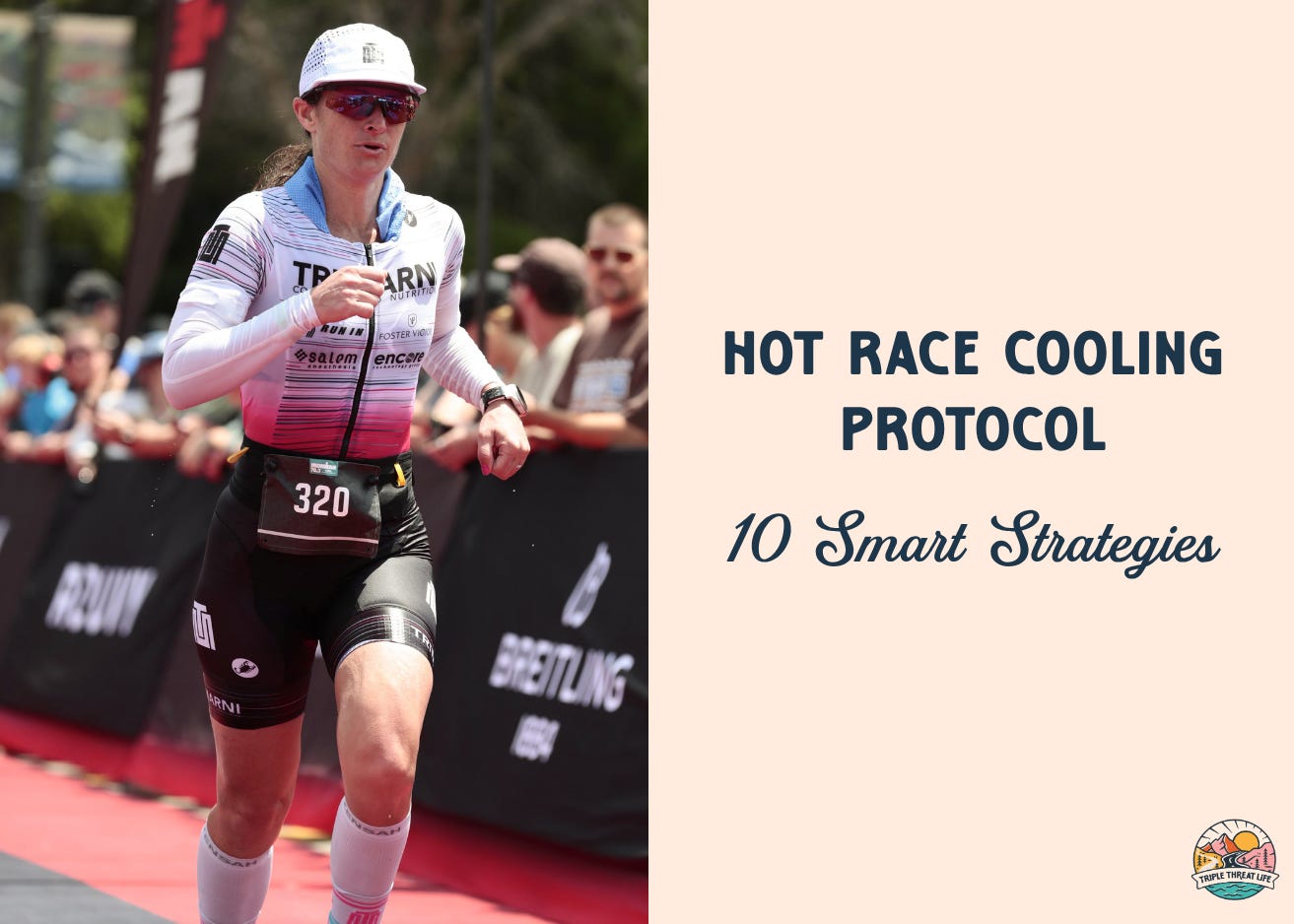
I was concerned about a few things heading into Chattanooga 70.3…
Number 1- We weren’t heat acclimated (like at all). Weirdly, Florida has been unseasonably cool, and we only had a few days that got up to 85° before the race.
Number 2- I have a very high sweat rate (like 3.7 lb an hour) so hot conditions have traditionally been very challenging for me.
After talking with my coach, she wasn’t as concerned. She was happier that we got in an extra 4-6 weeks of good quality training, instead of struggling in the heat. This is because quality training improves fitness, and fit athletes hold up better in the heat.
Still, she didn’t want to mop up a puddle of Brittany on the race course… So, we created a strategic cooling plan. Honestly, the plan was to throw everything at it that we could and pray for the best!
If you read my race report from Chattanooga 70.3, you saw that I hinted at my super secret cooling protocol…
This is something I’d typically reserve for paid subscribers, because it goes deeper into our training/race process. BUT I think it’s super important for everyone to know. So consider this my gift to you and a preview of what our TTL Club members get access to.
Hopefully, this will help you race smarter in the heat and have your best performance yet!
*Become a paid subscriber for access to the video vault with 60+ instructional videos, free Triathlon Foundations e-book, discounts to a dozen top brands, members’ only posts, and expert webinars.
Spoiler Alert: Our next webinar guest will be pro triathlete, Grace Alexander, who just won back-to-back races at 70.3 Gulf Coast and 70.3 Chattanooga.
Why racing in the heat is so hard
To understand why cooling strategies are so important, you first have to understand why racing in the heat is so hard.
As you exercise, your heart pumps blood to support hard-working muscles with the oxygen they need. But every muscle contraction also produces heat. To prevent your core temperature from rising too high, the body attempts to offload some of that heat by directing it toward the skin’s surface. That’s why you sweat!
When the sweat on your skin evaporates into the air, it takes excess heat with it, which helps cool you off. But when it’s hot and humid, the air is already saturated with moisture, so your sweat can’t evaporate. If your body can’t offload heat, and you keep exercising at a high intensity producing more heat, guess what happens?
You risk overheating, dehydration, gut issues, and your performance will suffer.
Complications when racing in the heat
Dehydration- When exercising in the heat, you lose fluid through sweat. If fluid and sodium aren’t replaced, your blood volume will decrease, which puts extra strain on your cardiovascular system. Your heart tries to compensate by beating faster, which causes your heart rate to rise even higher (cardiac drift). Also, your blood becomes thicker making it harder to circulate.
Overheating- If your core temperature gets too high, your body will shut down as a self-protection mechanism. No matter how much you want to keep going, if your core temperature reaches a dangerous threshold, your body will stop, often immediately. (That’s why you see athletes in hot races like Kona stopping just a mile from the finish.)
Gut issues- During exercise, blood flow is diverted away from the stomach to support the muscles that need it more. At hot races, this effect is compounded as the body tries to cool itself. Less blood flow means your digestion is compromised. That’s why many athletes experience gut issues when racing in the heat.
Performance decline- The body always prioritizes safety over performance. If you aren’t slowing down, the temperature isn’t changing, and you aren’t using cooling strategies, the body will direct resources to cool the skin and away from muscle contractions.
My coach just wrote about racing in the heat, so I wanted to borrow her explanation of a big mistake athletes make at hot races.
“One of the biggest mistakes athletes make in hot conditions is trying to maintain paces or power outputs that would normally feel manageable in cooler weather. The harder you work in the heat, the more metabolic heat your muscles generate. This creates a vicious cycle where rising effort leads to rising body temperature, which increases cardiovascular strain and further limits performance… Athletes who perform best in hot races are usually the ones who minimize dramatic slowdowns later in the event rather than forcing aggressive pacing early on.” - Marni Sumbal
Read her article- Heat Management Tips: The Gear You Need to Thrive (Not Just Survive)
10 essential cooling strategies for hot triathlons
So, how can you manage racing the heat and still have a good performance? Here are the 10 cooling strategies that I implemented at Chattanooga 70.3 on a day when the high reached 90.
* My favorites. These helped me the most!
1. Pacing*
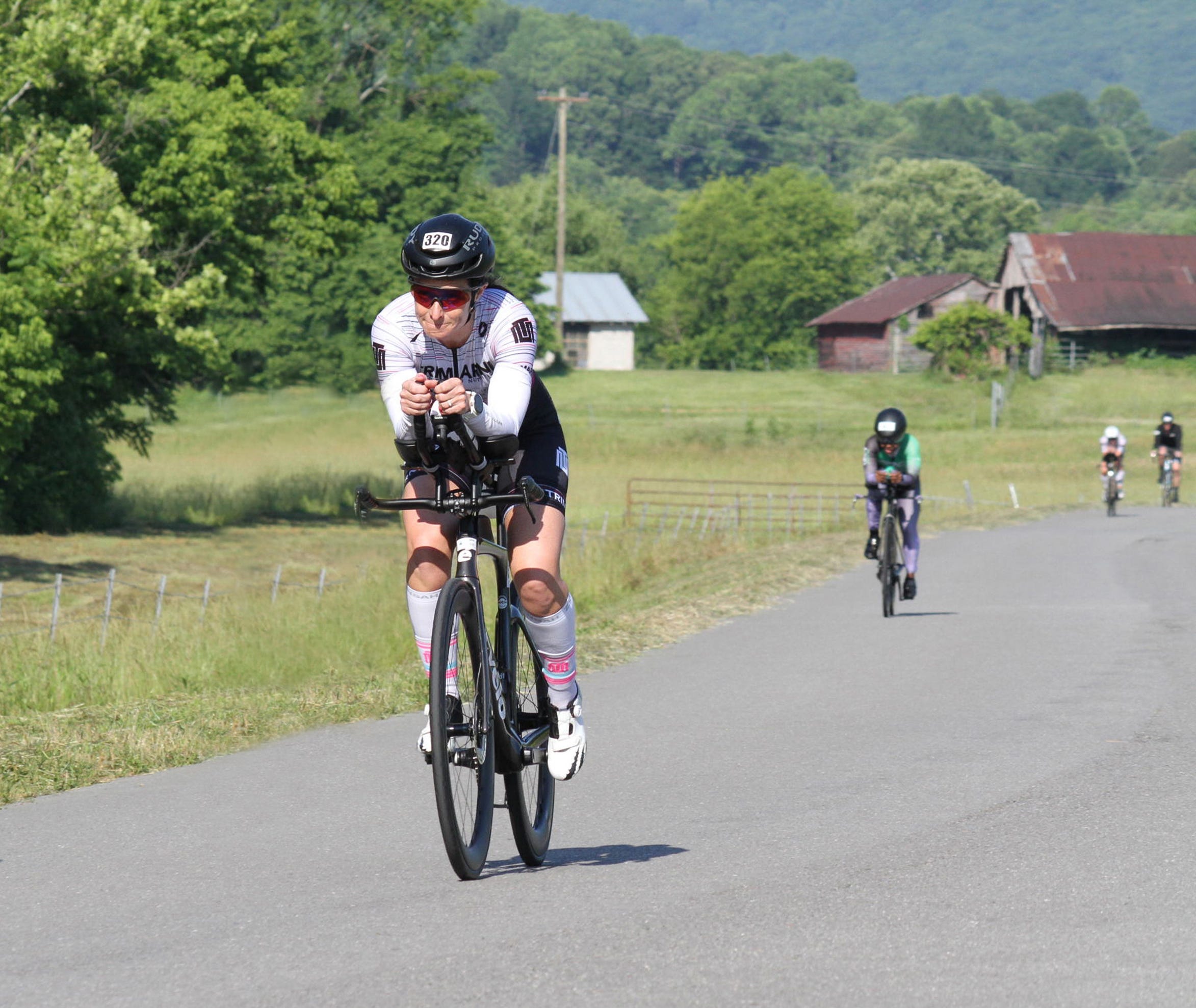
This doesn’t mean your goal power, run splits, or whatever numbers you’ve convinced yourself you should hold for a 70.3. This means thinking about how you approach the swim and bike so you can race strong, but still set yourself up for success on the run, which is where the heat will really take a toll.
On the bike, you have some cooling from the wind, but at a course like Chattanooga that’s mostly exposed, the run is where the heat will get you. Also, the run is the final event, so you’re likely more dehydrated at this point and your core temperature is higher than when you started the race.
Chattanooga is great because the run is two laps. We were given very specific instructions not to push the pace on the first lap. The way I thought about this was best ez pace +, not easy but not hard. If at any point, it started to feel like an interval, I should back off.
Also, I do not look at my watch when I run, and if I do, it’s only to double-check my heart rate against what I’m feeling. If you can’t resist, flip your screen to heart rate only or miles only. The worst thing you can do at a hot race is attempt to run a certain pace.

2. Ice vest
Ah, this is an interesting one. The wild card, because we’d actually never tried it before. Pre-cooling is used quite a bit in cycling events, but not so much in triathlon. But we thought it was worth a shot.
I purchased an ice vest from Alpha Cool, and we froze it overnight. The idea was to wear it over my trisuit on race morning and during the walk to the swim start in an effort to keep my core temperature as low as possibly before the race began.
It felt nice and by the time I was ready to put on my wetsuit, it had lost most of its cold feeling. (5:15 am-7:00 am)
*Amazon partner, if you purchase an item from a link, we may receive a small commission at no extra cost to you.
3. Cooling arm sleeves*
This was another new addition to our cooling protocol, although I had tested it in training prior to the race. My coach suggested wearing cooling arm sleeves. They wick moisture away from the skin, provide sun protection, and stay wet when you pour water on them at aid stations.
I got these cooling sleeves from Pearl Izumi. They’re thin and comfortable. I honestly forgot I was wearing them. The only question was whether to put them on in T1 or T2. Since the bike was going to be the longest event, and I needed to cool myself during that to prepare for the run, we opted for T1. A bit slower transition, but it was well-worth it as this is one of the strategies that I think helped the most.
4. Cooling neck towel
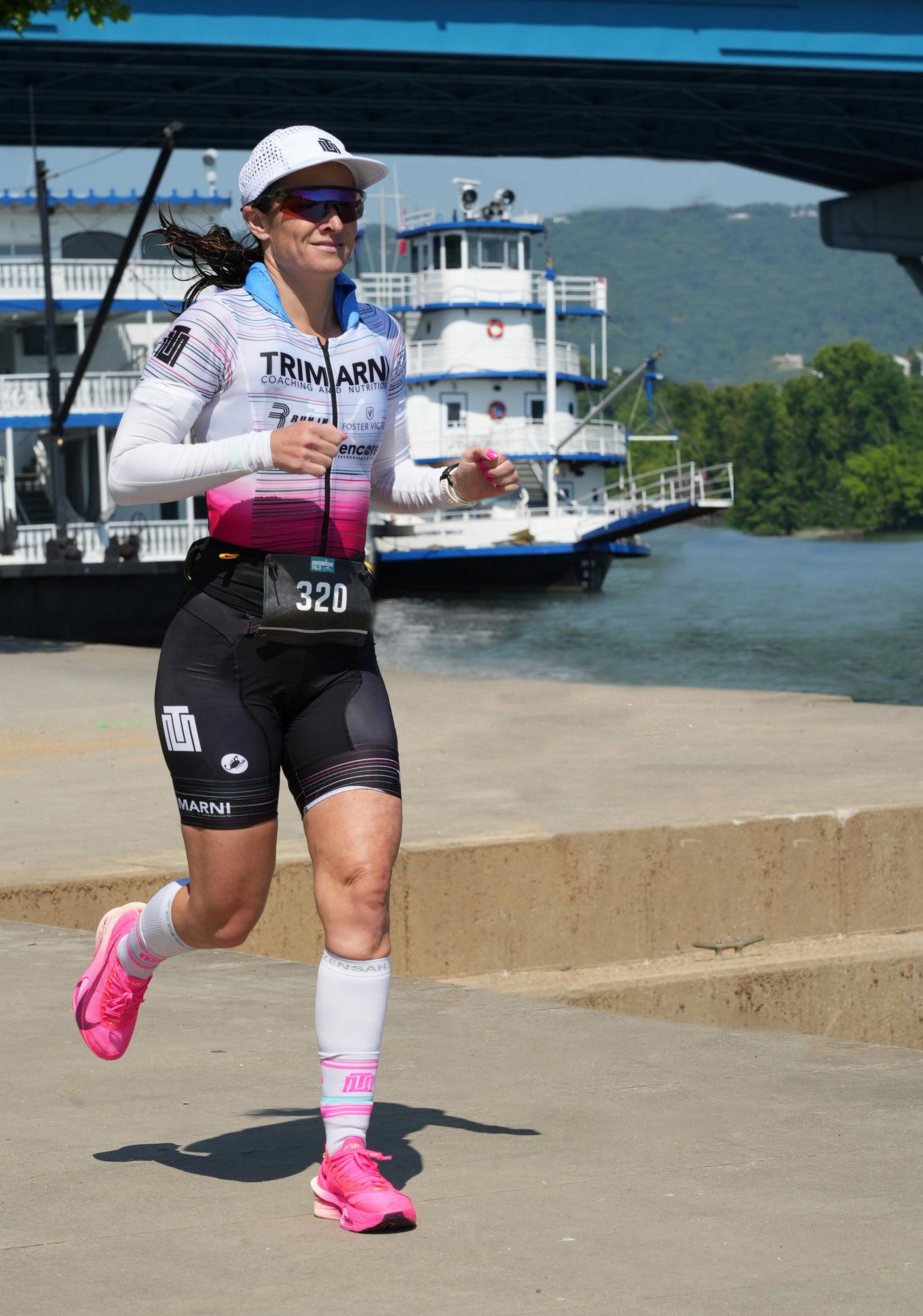
This is something I regularly use in training. During training runs, I wet this blue PVA towel, line it with ice, wrap it around my neck, and tuck it in my sports bra. The ice melts, the towel stays wet, and it keeps me cool.
During the race, we wet the towel and froze it overnight in a Ziplock bag that I kept in transition. Every time I would dump water on my head at an aid station, the towel would soak up water, so I could squeeze it on myself.
But you have to use the right kind of towel, otherwise it’s just a wet rag. This PVA material will be stiff as a board until it’s wet. Then, it stays chill.
5. Ice hat*
This was a brand-new addition to my gear that we got just before the race. Our friends at bambu werx created this special ice hat with a perforated top, ice pocket in the front, and adjustable drawstring.
Typically, I don’t like to wear hats when running. They don’t fit well, make me feel hot, and move my sunglasses around. But with the drawstring in the back, I could adjust this hat so it fit me perfectly. The pocket in the front holds ice, so at every aid station I would fill it up, and the ice would last almost until the next aid station. This was amazing and something I will use at every hot race from now on.
I appreciate each and every subscriber, free and paid! You will notice there are no ads here. This newsletter is only made possible through the generosity of paid subscribers. If you enjoy my writing, consider supporting my work with a paid subscription.
6. Frozen run bottle*
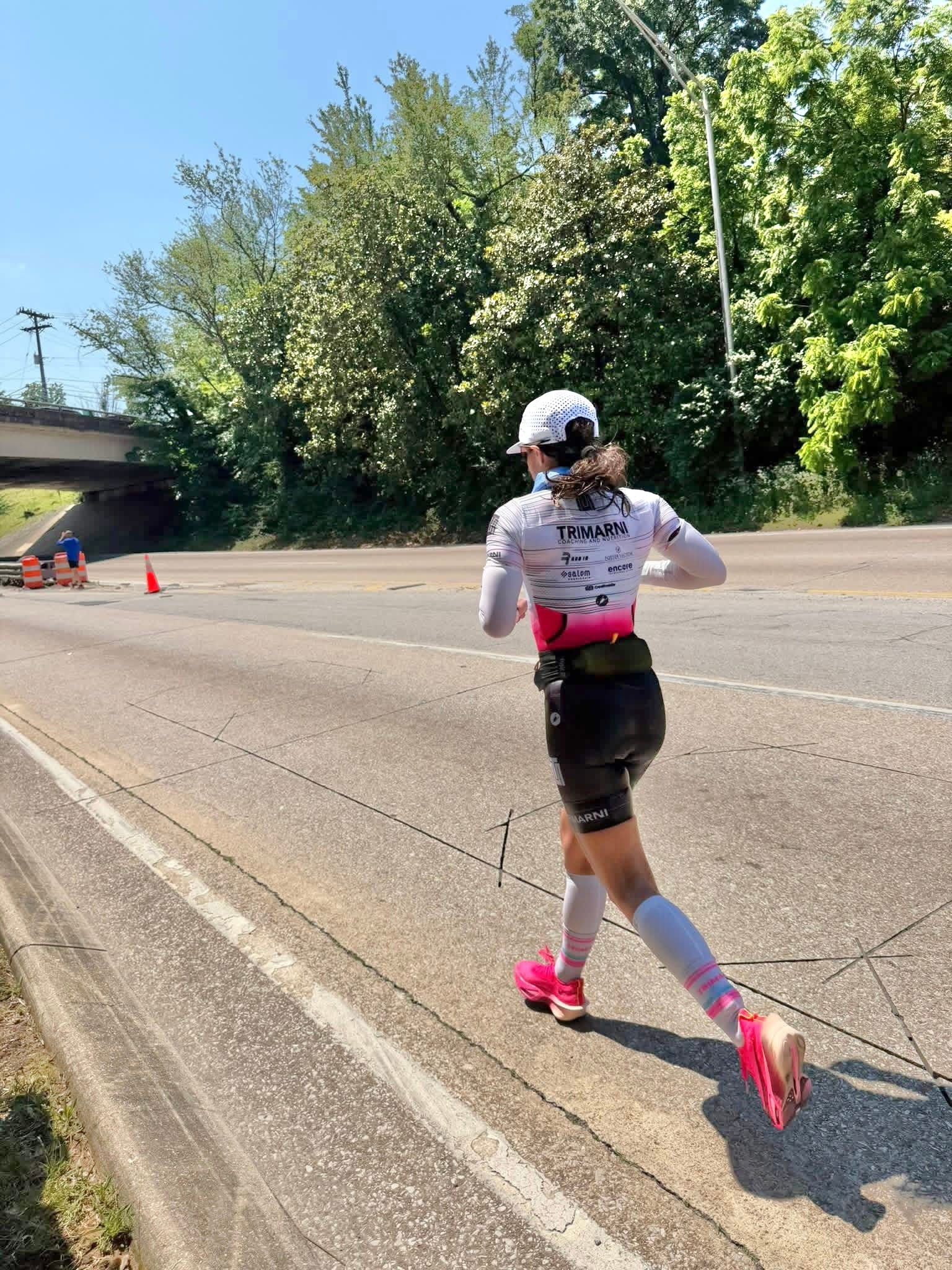
This is something we tried for the first time at this race! My coach suggested freezing our run bottles. Then, we put them in a tiny fabric cooler my friend had in transition. The only downside was with four frozen bottles inside, the cooler stayed very cold so it took a good 15 minutes before I could drink much out of it. But it was a total game changer.
I’m supposed to get through 20 oz. an hour and replace with more powder and water for the remainder, but I never get through that much in a race. This was the most I’ve ever drank during a race! (30 oz.) Having cold liquid was the difference.
All of us use the Naked Run band to carry our run bottles. It’s lightweight, double-layer mesh, you can stash a 20 oz. bottle in the back, and it doesn’t bounce. Once you get used to wearing it, you won’t even know it’s there. It also has bungees for your bib number and plenty of space to carry gels or a replacement bag of powder. This Amphipod 20 oz. bottle fits perfectly in the back. Carrying a handheld bottle contributes to fatigue and affects run form, so this is a much better strategy.
Carrying your own hydration for triathlon is crucial and so overrated. Not only do you get to use a product you’ve tested in training, you can drink more frequently when you want, instead of fuel consumption being dictated by an aid station. Cold liquid is easier to drink, and cools you from the inside.
7. Ice in run bottle
When my run bottle was almost empty, it started to get warm… I had a moment where I wanted to stop drinking. So, I ran through an aid station, I filled it up with cold water and ice! Then, I put in my replacement bag of powder from my run band, and I was good to go again with cool liquid to drink for the remainder of the run.
Grab a copy of my latest book: The Complete Guide to Your First 70.3 Triathlon.
8. Water and ice at aid stations*
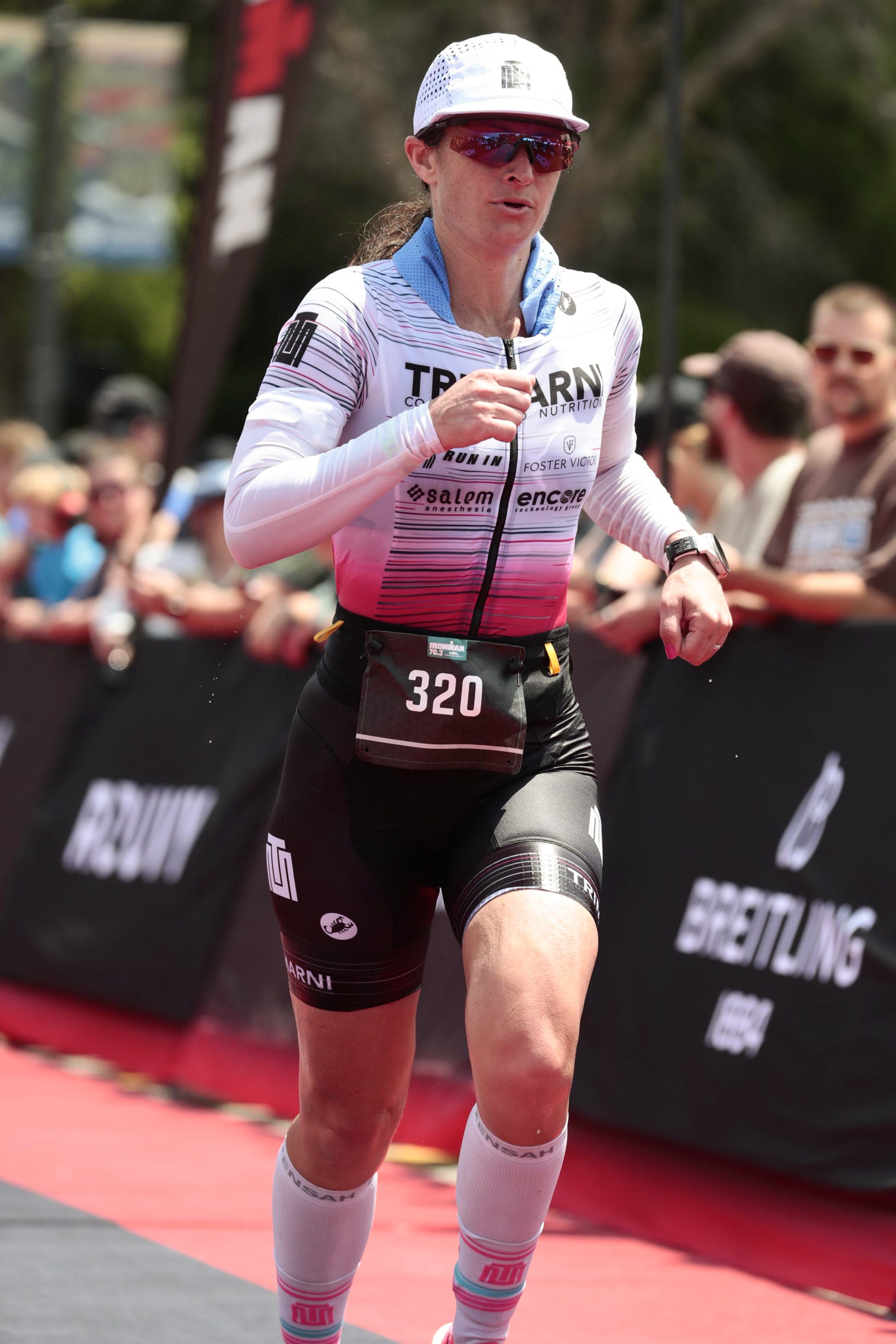
Here’s my aid station procedure for every hot race. Walk at the start of the aid station and grab water to pour over my head. Jog to the end of the aid station and grab ice to put in my sports bra and hat.
Then, as I run, I hold an ice cube in my hand and swap it back and forth. This is key, because the skin on your hands is glabrous, meaning it has amazing vascular properties for cooling. You can lower your core body temperature by holding ice. It’s been my secret weapon for like 5 years now. I even eat some of the ice chips. It helps. Cool your body from the inside, remember.
The ice and water is important, but don’t miss the walking part… Taking 15-20-30 seconds to lower your heart rate and reset form means you can run faster for longer. Walk breaks are essential during long-distance triathlon and will help you go faster!
Cooling yourself with water actually starts long before the run. It starts on the bike. We carry our own nutrition on the bike, so we don’t need anything at aid stations, except for one thing… water! During a hot race, grab a bottle of cold water at every aid station and pour it over your head, back, and legs.

9. Gels, no chews
This wasn’t my favorite idea when coach told me about it… but I understand the theory behind it. Typically, I have all my carbs in my bike bottle- 60g. Then, I supplement with a 40g chew spread throughout the entire bike, so my total per hour gets up to 75g.
The only thing is I really like my chews and don’t really like my gels. But the idea was to make digestion as easy as possible in the heat. Therefore, we opted for liquid nutrition only. But I’m excited to use my chews at cooler races! ;)
10. Extra sodium in bottles*
My coach is also a sports dietician (that means she can help you with your nutrition even if she’s not your coach, it’s true!) She always has me add more sodium to my bottles. Have you even looked at your sports drink to see how much sodium is in it? Chances are, it’s not enough.
We added 600mg of sodium to each bottle, per hour. I feel like this made a big difference in my ability to drink, manage blood pressure, and promote good digestion. If you’re just drinking plain water and not any sodium, or not enough, you risk a dangerous condition called hyponatremia (nausea, confusion, muscle weakness, loss of consciousness- all bad). But even if it doesn’t get to that point, not drinking enough liquid and not having enough sodium will impact your body’s ability to digest nutrition properly and use it to fuel your effort.
Overall, I feel like good pacing combined with using cooling sleeves, my ice hat, and freezing my run bottle made the biggest difference in delivering my best hot race performance yet!
If you enjoyed reading this, share it with a fellow athlete.